TRENDING
Is SEO Dead Because of AI? What Businesses Need to Know in 2026
Short answer: No. SEO is not dead because of AI. But the old version of SEO is.
For more than two decades, businesses have invested in search engine optimization to appear on Google when potential customers search for products, services, answers, and solutions.
But search behavior is changing.
People are no longer relying only on traditional Google results. They are increasingly using AI-powered experiences such as Google AI Overviews and AI Mode, ChatGPT, Gemini, Perplexity, and other generative search tools to research questions, compare options, discover brands, and make decisions.
That creates a legitimate concern for businesses:
If AI can answer the user’s question without sending them to a website, does SEO still matter?
Yes,but the objective of SEO is changing.
SEO is moving from simply “ranking a webpage” to building a website, brand, and body of information that search engines and AI systems can discover, understand, trust, cite, and recommend.
Google itself now explicitly states that SEO remains relevant for generative AI search because Google’s AI search experiences are grounded in its core Search systems and web index.
The businesses most likely to struggle are not necessarily those that use SEO.
They are businesses still using old SEO tactics:
- Publishing hundreds of generic AI-generated articles
- Targeting keywords without understanding search intent
- Rewriting competitors instead of creating something original
- Focusing only on rankings
- Ignoring brand authority
- Ignoring first-hand experience
- Treating backlinks as the entire SEO strategy
- Measuring success only through organic clicks
The future is different.
SEO + AI Search + Brand Authority + First-Hand Expertise + Useful Content + Technical Foundations is becoming the stronger model.
The State of SEO in 2026: What Has Actually Changed?
Before declaring SEO dead, it is important to separate what has changed from what has not changed.
Search has changed significantly.
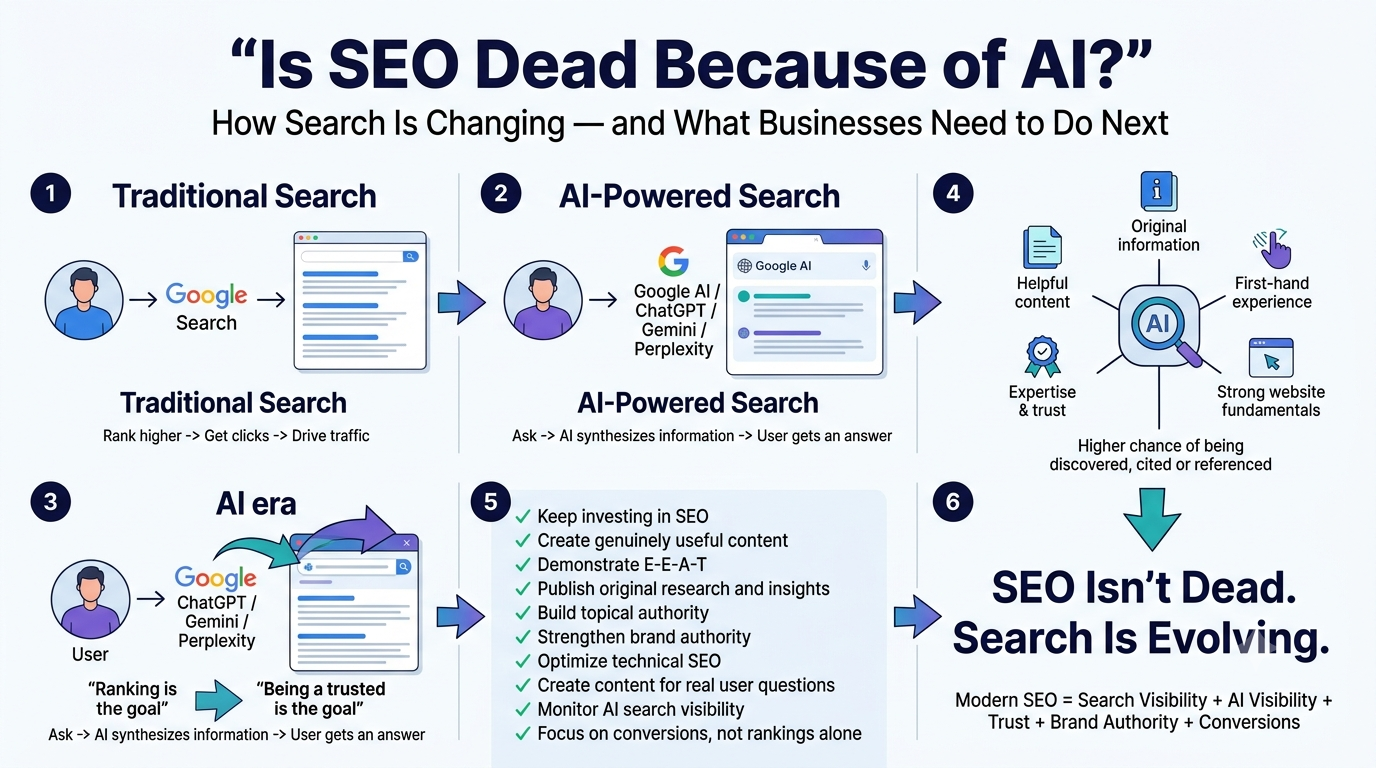
The traditional journey looked something like this:
User → Google → Search results → Website → Answer
The new journey can look like:
User → Google AI / ChatGPT / Gemini / Perplexity → Synthesized answer → Selected sources → Website
Sometimes the user never visits a website.
That is the biggest challenge facing publishers and businesses.
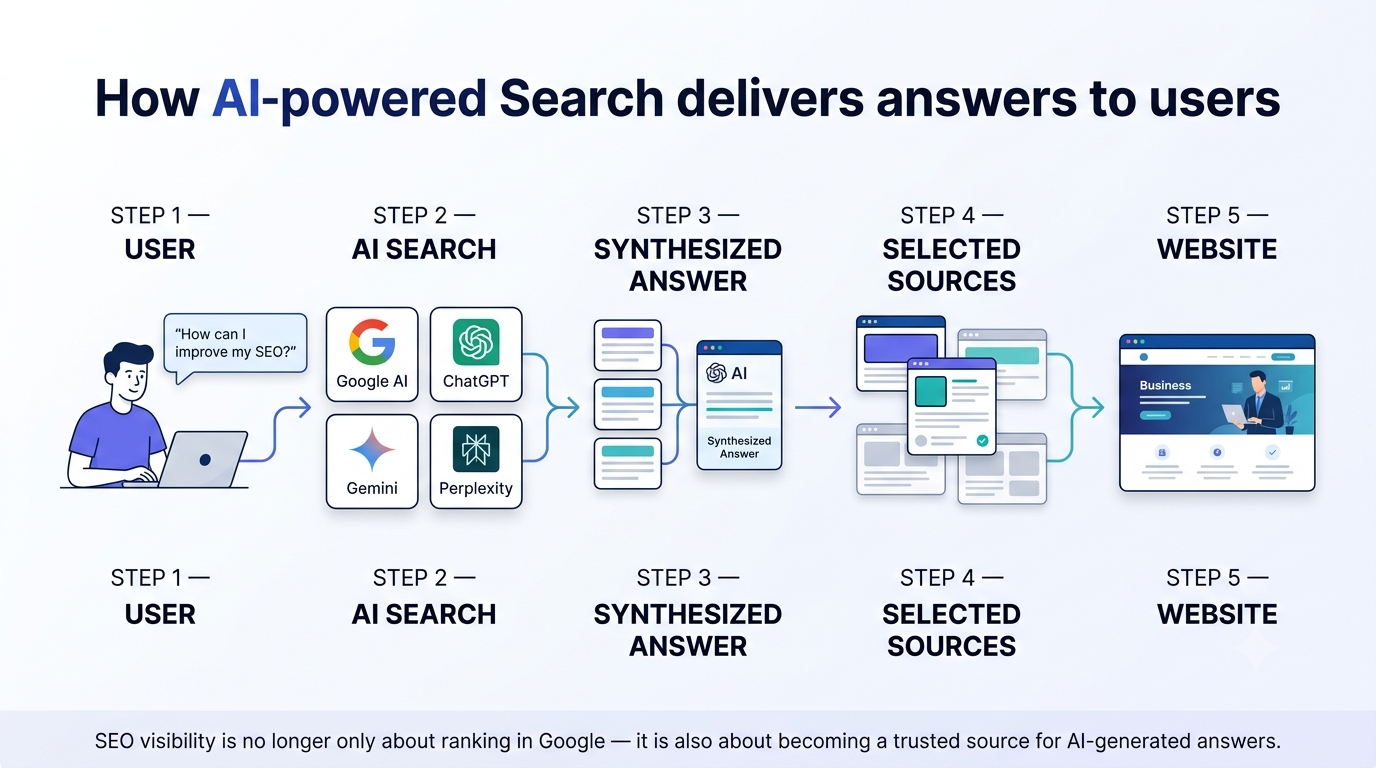 The State of SEO in 2026 What Has Actually Changed – How AI powered serach delivers answers to users
AI Overviews Are Changing Organic Click Behavior
Research from Ahrefs provides an important data point.
In its initial study of 300,000 keywords, Ahrefs found that the presence of an AI Overview correlated with approximately a 34.5% lower click-through rate for the top-ranking page compared with comparable informational searches without an AI Overview.
Ahrefs later repeated the analysis using December 2025 data and reported an even larger estimated impact: the presence of an AI Overview correlated with approximately a 58% lower CTR for the #1 organic result.
That is significant.
But it does not mean that SEO has become useless.
It means something more important:
Ranking #1 is no longer the complete definition of search visibility.
A business can rank #1 and still receive fewer clicks than it historically did.
At the same time, a business that appears as a source inside an AI-generated answer may receive visibility even when the user doesn’t behave like a traditional searcher.
Users Are Already Encountering AI Search
This isn’t a theoretical future.
Pew Research Center analyzed browsing behavior from 900 U.S. adults and found that 58% conducted at least one Google search in March 2025 that produced an AI-generated summary.
The behavior around those searches is particularly important.
Pew found:
- Traditional search-result links were clicked in 8% of visits when an AI summary appeared.
- Traditional result links were clicked in 15% of visits when there was no AI summary.
- Links inside the AI summary itself were clicked in only 1% of visits.
- Users ended their browsing session on 26% of pages with an AI summary, compared with 16% without one.
This tells businesses something important.
The challenge isn’t simply:
“Can I rank?”
The bigger question is:
“How do I remain visible and valuable when users can get an answer before visiting my website?”
That is where modern SEO becomes more interesting.
So, Is SEO Dead?
No. SEO Is Becoming More Important But Less Click-Centric.
Google’s own 2026 guidance is particularly clear on this point.
Google says that its generative AI search experiences rely on core Search systems to retrieve relevant information from its index. It specifically recommends continuing foundational SEO practices while focusing on unique, valuable, non-commodity content.
In other words:
AI Search does not eliminate SEO.
AI Search changes how SEO creates value.
Traditional SEO often focused on:
Ranking → Click → Traffic
Modern search visibility increasingly needs to consider:
Discovery → Ranking → AI retrieval → Citation → Brand visibility → Click → Conversion
And sometimes:
Discovery → AI recommendation → Brand search → Direct visit → Conversion
This is why businesses should stop thinking about SEO as simply a traffic-generation channel.
SEO is becoming part of a broader digital discovery system.
What AI Cannot Easily Replace
AI is very good at synthesizing information.
If 100 websites all publish the same basic explanation of:
“What is SEO?”
an AI system has little reason to prefer one generic article over another.
That creates a major opportunity for businesses.
AI can summarize common information.
It is much harder to summarize unique information that doesn’t exist elsewhere.
For example:
Generic content
“SEO is the process of optimizing a website to improve its visibility in search engines.”
Thousands of websites can say this.
Original content
“We analyzed 120 pages across 18 B2B websites and found that service pages with comparison tables generated 2.4× more assisted organic conversions than equivalent pages without them.”
Now there is something interesting.
It contains:
- Original research
- First-hand analysis
- Data
- A methodology
- A specific observation
- Something other websites can reference
That is much stronger content.
And this is closely aligned with Google’s current guidance, which encourages original information, research, analysis, first-hand expertise, and content that provides substantial value beyond what already exists.
The Biggest SEO Mistake Businesses Can Make in the AI Era
The biggest mistake isn’t using AI.
It is using AI to create content that has no reason to exist.
Consider this workflow:
Keyword → ChatGPT → Article → Publish → Repeat
A business can theoretically produce hundreds of articles this way.
But if those articles simply summarize information already available online, the website hasn’t created a meaningful competitive advantage.
Google explicitly warns against producing large amounts of content primarily to manipulate rankings. It also says that using generative AI to create many pages without adding value can fall under its scaled content abuse policies.
Google’s guidance is not:
“Never use AI.”
It is closer to:
Use AI as a tool, but make sure the final content provides real value.
That distinction matters.
AI Content Is Not Automatically Bad for SEO
This is one of the biggest misconceptions surrounding AI and SEO.
Google has explicitly stated that appropriate use of AI-generated content is not automatically against its Search guidelines.
The important question is why and how the content was created.
Google says AI-generated content can perform well when it is useful, original, high quality, and demonstrates qualities associated with E-E-A-T. But using automation primarily to manipulate search rankings violates its spam policies.
So there are two very different approaches.
Bad AI SEO
AI → Generate → Publish → Repeat
Better AI-assisted SEO
Research → First-hand expertise → Human strategy → AI assistance → Expert review → Original insights → Evidence → Publish → Measure → Improve
The second model is much more defensible.
What Does E-E-A-T Mean in the AI Era?
E-E-A-T stands for:
- Experience
- Expertise
- Authoritativeness
- Trustworthiness
Google explains that E-E-A-T itself is not a single ranking factor, but its systems use a variety of signals that can identify content demonstrating these qualities. Google also states that trust is the most important component of E-E-A-T.
This becomes even more important in an AI-heavy search environment.
Why?
Because AI systems have an enormous amount of information available to them.
The competitive advantage is no longer simply:
“Can you produce information?”
AI can produce information extremely quickly.
The advantage becomes:
“Can you demonstrate that your information is accurate, experienced, trustworthy, original, and worth referencing?”
How to Build E-E-A-T Into Your SEO Strategy
1. Show Who Created the Content
Don’t hide the author.
A serious business blog should ideally include:
- Author name
- Professional role
- Relevant experience
- Author bio
- Links to relevant professional profiles where appropriate
- Editorial/reviewer information where useful
Google specifically recommends making it clear who created content and using accurate bylines where readers would reasonably expect them.
This is much stronger than:
“Admin | Posted September 9, 2026”
2. Demonstrate First-Hand Experience
Experience is becoming one of the most valuable differentiators in content.
Instead of saying:
“Here are 10 SEO strategies businesses should use.”
Show what happened when you used them.
For example:
Weak
“Internal linking can improve SEO.”
Stronger
“We redesigned the internal linking structure across 85 pages on an e-commerce website. The goal was to connect informational blog content with commercial category and product pages. Over the following months, organic traffic increased from X to Y.”
The second example gives the reader something that a generic AI-generated article cannot easily provide:
experience.
If you have client permission, use:
- Screenshots
- Search Console data
- GA4 data
- Before/after traffic
- Ranking changes
- Conversion data
- Content examples
- Methodology
- Challenges
- What failed
- What you changed
That is genuine E-E-A-T.
3. Publish Original Data
This may become one of the strongest content strategies for businesses competing with AI-generated content.
Instead of only publishing:
“What is SEO?”
publish:
“We Analyzed 500 B2B Websites: 7 SEO Patterns We Found”
Or:
“We Compared 100 AI Search Results: What Makes a Brand More Likely to Be Cited?”
Or:
“12 Months of SEO Data: What Actually Increased Organic Leads for Our Client?”
Original data creates something AI cannot simply manufacture from existing web content.
It also creates opportunities for other websites to reference your research.
That can lead to:
Research → Mentions → Links → Brand authority → Search visibility → AI citations
This is a much stronger long-term content flywheel.
4. Stop Writing Only About Keywords
This is another major shift.
Old SEO thinking:
“What keyword should we rank for?”
Modern SEO thinking:
“What does the user actually need to know?”
Suppose the target keyword is:
“SEO agency for small business”
A traditional content strategy might create:
Best SEO Agency for Small Business
A stronger content ecosystem might answer:
- How much does SEO cost for a small business?
- Is SEO worth it for a small business?
- How long does SEO take to work?
- Can a small business do SEO without an agency?
- What should an SEO agency actually do every month?
- How do I choose an SEO agency?
- What SEO metrics should a small business track?
- Why is my website not getting Google traffic?
- How can I get my business visible in AI search?
- Can AI replace an SEO agency?
- How does AI change SEO for small businesses?
Now you are covering the entire decision journey, not one keyword.
AI Search Makes Conversational Queries More Important
Pew’s research provides another useful insight.
Searches that were longer, question-based, or written as full sentences were more likely to trigger AI-generated summaries.
In its analysis, 60% of searches beginning with question words such as “who,” “what,” “when,” or “why” generated an AI summary, while only 8% of one- or two-word searches did. Searches with 10 or more words generated AI summaries in 53% of cases.
This doesn’t mean businesses should create a separate page for every possible question.
Google’s current guidance explicitly warns against creating large quantities of pages for search variations primarily to manipulate rankings or generative AI results.
Instead, businesses should create comprehensive topic ecosystems.
For example:
Core topic
AI SEO
Supporting questions:
- What is AI SEO?
- How does AI change SEO?
- Is SEO dead because of AI?
- How does Google AI search work?
- How do I get my website cited in AI search?
- Can ChatGPT send traffic to websites?
- How do I optimize content for AI search?
- What is GEO?
- What is AEO?
- What is the difference between SEO, AEO and GEO?
One strong pillar page can connect to detailed supporting content.
SEO, AEO and GEO Are Not Three Completely Separate Worlds
You will hear a lot about:
SEO
AEO — Answer Engine Optimization
GEO — Generative Engine Optimization
These terms can be useful for describing different aspects of search visibility.
But businesses should avoid treating them as completely separate technical hacks.
Google’s latest guidance explicitly says that businesses should prioritize established SEO fundamentals and valuable content rather than relying on supposed “AEO/GEO hacks.”
Think about it this way:
SEO
Helps search engines discover, crawl, understand and rank your content.
AEO
Focuses on providing clear answers that can satisfy question-based searches and answer-oriented experiences.
GEO / AI Search Optimization
Focuses on making your information useful and understandable within generative search experiences.
But underneath all three is the same foundation:
Useful information + technical accessibility + relevance + authority + trust + strong user experience.
What Businesses Should Do Differently Now
If you are still running an SEO strategy based primarily on:
- Keywords
- Blog volume
- Backlinks
- Rankings
you need to expand the strategy.
A stronger 2026 SEO framework looks like this:
SEO Area | Old Approach | AI-Era Approach |
Keywords | Exact-match keywords | Search intent + topic entities |
Content | Publish frequently | Publish useful, original content |
AI | Avoid completely | Use strategically with human oversight |
Research | Competitor research | Competitor + customer + original research |
E-E-A-T | Author bio | Evidence + experience + authorship + trust |
Links | Build as many as possible | Earn relevant authority |
Rankings | Main KPI | One visibility metric among several |
Traffic | Primary goal | Traffic + visibility + conversions |
AI Search | Ignore | Monitor citations and brand mentions |
Content | Generic information | Unique insights and first-hand knowledge |
Reporting | Rankings + sessions | Visibility + clicks + leads + conversions |
Does Ranking #1 Still Matter?
Yes.
Absolutely.
But ranking #1 should no longer be the only objective.
Imagine two businesses.
Business A
Ranks #1 for 50 keywords but:
- Nobody knows the brand
- Content is generic
- No original research
- Weak author information
- Few independent mentions
- No strong case studies
Business B
Ranks #3–#8 for some terms but:
- Has strong brand recognition
- Publishes original research
- Has expert authors
- Gets mentioned by industry websites
- Has detailed case studies
- Produces useful videos
- Appears across search results
- Gets cited in AI-generated answers
- Has strong commercial pages
Business B may have a much stronger long-term search position.
Why?
Because modern search visibility is becoming increasingly multi-surface.
Your brand can appear through:
- Traditional organic results
- Featured snippets
- AI Overviews
- AI Mode
- Videos
- Images
- Local results
- News
- Forums
- Reviews
- Third-party websites
- Brand mentions
- AI-generated recommendations
SEO is therefore becoming less about owning one ranking position and more about owning your topic and building your brand’s digital evidence.
How AI Can Actually Make SEO Better
AI is not only a threat to SEO.
Used properly, AI can make SEO teams significantly more efficient.
AI for Keyword and Topic Research
AI can help identify:
- Related questions
- Search intent
- Topic gaps
- Content clusters
- Long-tail queries
- Customer objections
- Comparison questions
- Conversational searches
But human validation is still important.
AI for Content Research
AI can help organize:
- Customer questions
- Competitor topics
- Search results
- Content gaps
- Industry terminology
- Frequently asked questions
The SEO strategist should then determine:
What deserves to be published?
AI for Content Creation
AI can assist with:
- Outlines
- First drafts
- Content briefs
- Headlines
- Meta descriptions
- Social posts
- Email drafts
- Content repurposing
- FAQs
- Video scripts
But AI should not become the source of fake expertise.
For example, don’t ask AI to invent:
- Client results
- Statistics
- Testimonials
- Expert opinions
- Research findings
- Product testing
- Customer experiences
Those should come from real evidence.
AI for Image Creation
AI can help businesses create:
- Blog illustrations
- Social media graphics
- Infographics
- Ad concepts
- YouTube thumbnails
- Educational diagrams
- Product concept visuals
But visuals should support the content rather than exist only to make an article longer.
AI for Video Content
A single SEO article can become:
1 Blog
↓
1 YouTube video
↓
3–5 short videos
↓
5 social posts
↓
1 LinkedIn post
↓
1 infographic
↓
1 email
This is where AI becomes particularly powerful.
It can reduce the time required to turn one strong piece of research into a complete content ecosystem.
AI Automation Is the Next Layer of SEO
AI can also connect SEO with marketing automation.
What Should Businesses Measure If SEO Clicks Decline?
This is one of the most important questions.
If AI search creates more zero-click behavior, simply looking at:
Organic sessions
may give you an incomplete picture.
Businesses should consider tracking:
Traditional SEO Metrics
- Organic impressions
- Organic clicks
- Rankings
- CTR
- Organic conversions
- Revenue from organic search
Brand Metrics
- Branded searches
- Direct traffic
- Brand mentions
- Referral traffic
- Search demand
AI Search Metrics
Where reliable measurement is available:
- AI citations
- AI mentions
- Brand inclusion
- Pages appearing in AI-generated results
- Referral traffic from AI platforms
- Assisted conversions
Business Metrics
Most importantly:
- Leads
- Qualified leads
- Sales opportunities
- Revenue
- Customer acquisition cost
- Conversion rate
Because the ultimate purpose of SEO isn’t:
“We ranked #1.”
It is:
“Our business became easier to discover and generated measurable business value.”
The New SEO Funnel for Businesses
A modern SEO strategy can look like this:
Stage 1 — Discovery
User asks:
“What is SEO?”
Your content educates them.
Stage 2 — Problem
User asks:
“Why isn’t my website getting traffic?”
Your content explains possible causes.
Stage 3 — Solution
User asks:
“How can I improve my SEO?”
Your strategy guide helps them.
Stage 4 — Comparison
User asks:
“Should I hire an SEO agency or do SEO myself?”
Your comparison content helps them evaluate options.
Stage 5 — Commercial
User asks:
“Best SEO agency for my business?”
Your service page becomes relevant.
Stage 6 — Trust
They see:
- Case studies
- Reviews
- Results
- Author expertise
- Research
- Client examples
Stage 7 — Conversion
They contact your business.
This is far more powerful than publishing 100 disconnected blog posts.
What Will Happen to Low-Quality SEO Content?
This is probably where AI will hurt SEO the most.
There will be less value in publishing content such as:
“10 Benefits of SEO”
followed by ten generic paragraphs that could have been generated in 30 seconds.
There is also less value in publishing:
“What is Digital Marketing?”
when the page simply repeats information already available across thousands of websites.
The web already has enough generic content.
The opportunity is to create content that contains:
- Original research
- First-hand experience
- Expert commentary
- Proprietary data
- Real examples
- Case studies
- Screenshots
- Experiments
- Comparisons
- Calculations
- Industry insights
- Unique frameworks
- Practical templates
- Real customer questions
That’s what creates differentiation.
A Practical AI-Era SEO Strategy for 2026
If I were building an SEO strategy for a business today, I would structure it around six layers.
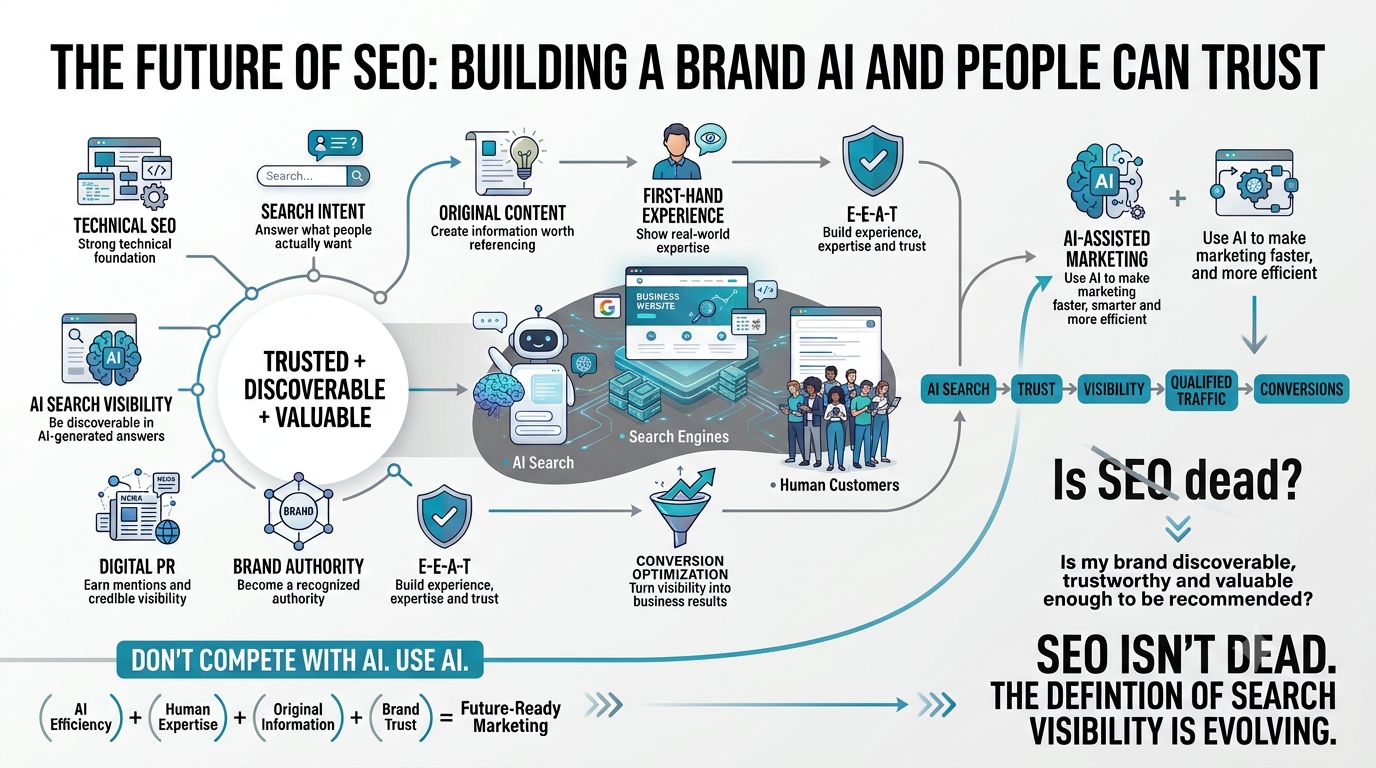
Layer 1: Technical SEO
Make sure search engines and AI systems can access the website.
Focus on:
- Crawlability
- Indexability
- Site architecture
- Internal links
- Canonicals
- Structured data where appropriate
- Mobile usability
- Page experience
- Core Web Vitals
- HTTPS
- JavaScript rendering
- XML sitemap
- Clean URLs
Google’s current generative AI guidance specifically says technical SEO fundamentals remain relevant because generative AI search relies on Google’s underlying Search systems and index.
Layer 2: Search Intent
Understand what users actually want.
Don’t just target:
“SEO services”
Also understand the questions behind it:
- How much does SEO cost?
- Is SEO worth it?
- How long does SEO take?
- What does an SEO agency do?
- Why isn’t my website ranking?
- How do I get more organic leads?
- How do I measure SEO ROI?
Layer 3: Topical Authority
Build interconnected content around important topics.
For example:
AI SEO
→ AI Search
→ Google AI Overviews
→ ChatGPT SEO
→ Gemini Search
→ Perplexity
→ GEO
→ AEO
→ AI content
→ AI traffic
→ AI citations
→ AI visibility
This helps create a comprehensive knowledge ecosystem rather than isolated articles.
Layer 4: E-E-A-T
Demonstrate:
Experience
Real projects and first-hand observations.
Expertise
Qualified authors and knowledgeable explanations.
Authoritativeness
Industry recognition, citations, mentions and relevant references.
Trust
Transparent claims, evidence, accurate information, clear authorship and honest limitations.
Google specifically recommends content that demonstrates first-hand expertise and makes the creator’s identity and background clear.
Layer 5: Brand Authority
Build visibility beyond your own website.
Consider:
- Industry publications
- Expert interviews
- Podcasts
- YouTube
- Relevant communities
- Digital PR
- Original research
- Partnerships
- Expert contributions
- Case studies
The objective is not simply to obtain backlinks.
The objective is to make the brand known and trusted within its category.
Layer 6: AI Search Visibility
Finally, understand how your brand appears in AI-powered search experiences.
Ask questions such as:
“What are the best SEO agencies for ecommerce?”
“Which digital marketing agencies specialize in AI SEO?”
“How can a small business improve SEO?”
“Which companies provide GEO services?”
“What is the best way to get traffic from ChatGPT?”
Then monitor:
- Which brands appear?
- Which websites are cited?
- What evidence is being referenced?
- Is your brand mentioned?
- Which competitors appear repeatedly?
- What topics trigger recommendations?
This turns AI search from a vague concept into something you can actually research.
10 Things Businesses Should Stop Doing in SEO
If AI is changing search, these outdated habits deserve reconsideration.
1. Stop publishing just because you have a keyword.
Start with the user problem.
2. Stop measuring SEO only by rankings.
Measure business outcomes.
3. Stop publishing generic AI articles at scale.
Add original value.
4. Stop hiding authors.
Show expertise.
5. Stop rewriting competitors.
Create something better or different.
6. Stop treating backlinks as the entire strategy.
Build authority and useful content.
7. Stop targeting only short keywords.
Understand conversational search intent.
8. Stop ignoring brand searches.
Brand demand matters.
9. Stop treating AI search as separate from SEO.
Build strong SEO foundations first.
10. Stop asking, “How do I trick AI into citing me?”
Ask:
“Why would an AI system have a reason to trust and reference my business?”
That is the better question.
The Real Future of SEO
SEO isn’t disappearing.
The economics of organic search are changing.
For years, the dominant objective was:
Get the highest ranking → receive the click.
Now the ecosystem is becoming:
Get discovered → become visible → become trusted → appear in search and AI experiences → earn the click when it matters → convert the visitor.
This is a fundamental shift.
And businesses that understand this early have an advantage.
Google’s own 2026 documentation says SEO remains relevant to generative AI search and emphasizes that valuable, unique, non-commodity content is particularly important.
At the same time, independent research shows that AI-generated summaries can significantly reduce traditional organic click-through rates.
Both things can be true.
SEO is still important.
Traditional SEO alone is no longer enough.
Final Answer: Is SEO Dead Because of AI?
No.
But keyword-first, volume-first, ranking-only SEO is becoming less effective.
The future belongs to businesses that take a complete approach to digital growth by combining technical SEO, search intent, original content, first-hand experience, E-E-A-T, brand authority, digital PR, AI search visibility, conversion optimization, and AI-assisted marketing. The biggest opportunity isn’t to compete with AI, but to use it strategically while building the expertise, trust, experience, and brand authority that AI cannot replace.
It is to use AI to make your marketing more efficient while creating the kind of information that AI systems, search engines, and—most importantly—people have a reason to trust.
The question businesses should be asking in 2026 isn’t:
“Is SEO dead?”
It is:
“If search is becoming AI-driven, is my brand still discoverable, trustworthy, and valuable enough to be recommended?”
If the answer is no, that’s the SEO problem worth solving.